Turn a run into an action and a client report
It is Monday morning and a new run has landed. This is what to do with it, and what to send the client when you are done.
How the plan is built
Every action comes from something measured in your own run. A domain that was actually cited, a page that actually failed, a search an engine actually ran. Nothing here is generated from a template about your industry.
Two consequences you will notice. A small project gets a short plan, and that is correct rather than disappointing. And a single citation on a single topic never becomes an action, because one page in one theme is not yet a pattern.
How actions are ranked
Cards are ordered by estimated impact, shown in points of visibility you could reasonably gain. The estimate is capped deliberately: no single action is presented as worth more than a few points, because nothing in AI search moves a score by twenty points on its own.
Some actions carry no estimate at all. A technical fix from the audit has an obvious value and a completely unpredictable size, so we leave it blank rather than invent a number. Those sort last, which does not mean do them last: a blocked crawler caps everything above it.
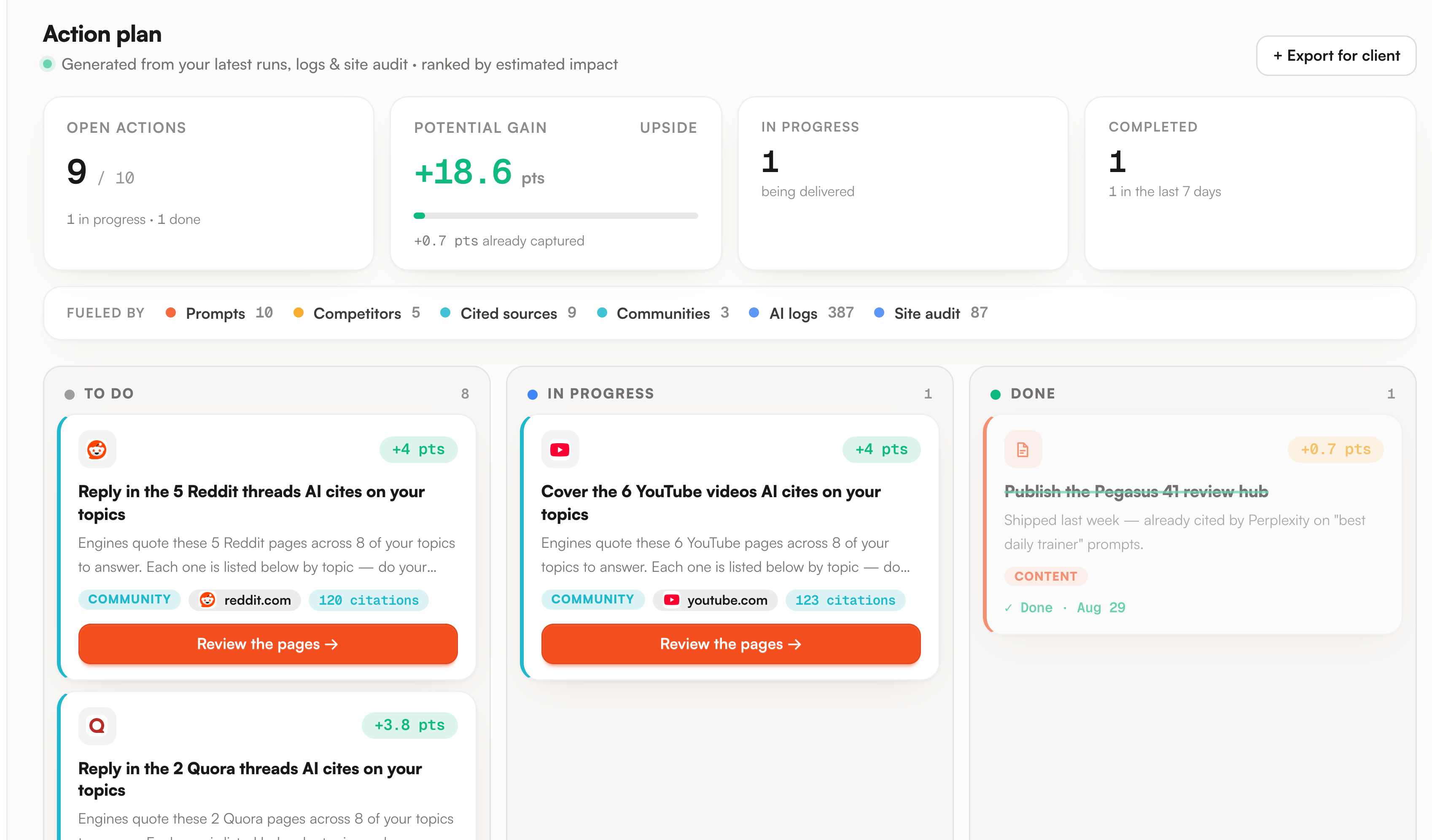
What is behind a card
Open one and you get the evidence it was built from, which is the part that makes it defensible in front of a client.
| Kind of action | Built from | What it asks you to do |
|---|---|---|
| A cited domain | The exact pages of that domain the engines quoted on your prompts | Something specific to that platform. A marketplace listing is not a forum reply, and a video is not a review. |
| A search theme | The searches engines really ran before answering, grouped by topic | Cover those angles. We know the engine looked for this, so it is not a guess about intent. |
| A technical finding | A failing check from your site audit | Fix access or a broken cited page. Usually the cheapest points on the board. |
The wording follows the platform, not a generic phrase. A page on a marketplace gets advice about that page. A real discussion thread gets advice about answering in it. Somewhere it makes no sense to reply, we do not tell you to reply.
One action a week, measured
This is the part that turns the product from a dashboard into a method, and it is worth the discipline.
Take the card at the top of To do, the one with the highest estimated impact, move it to In progress, and do nothing else from the board.
Mark it Done when it is live. Done cards count into the points already captured, and they flow into the next client report.
You changed one thing, so whatever moved is attributable to it. Ship five things in a week and you will never know which one worked.
This rhythm is also the honest answer to how long AI search takes. Some actions land in a week, some take a month, and some never move the number. You only find out which is which by changing one thing at a time.
The client report
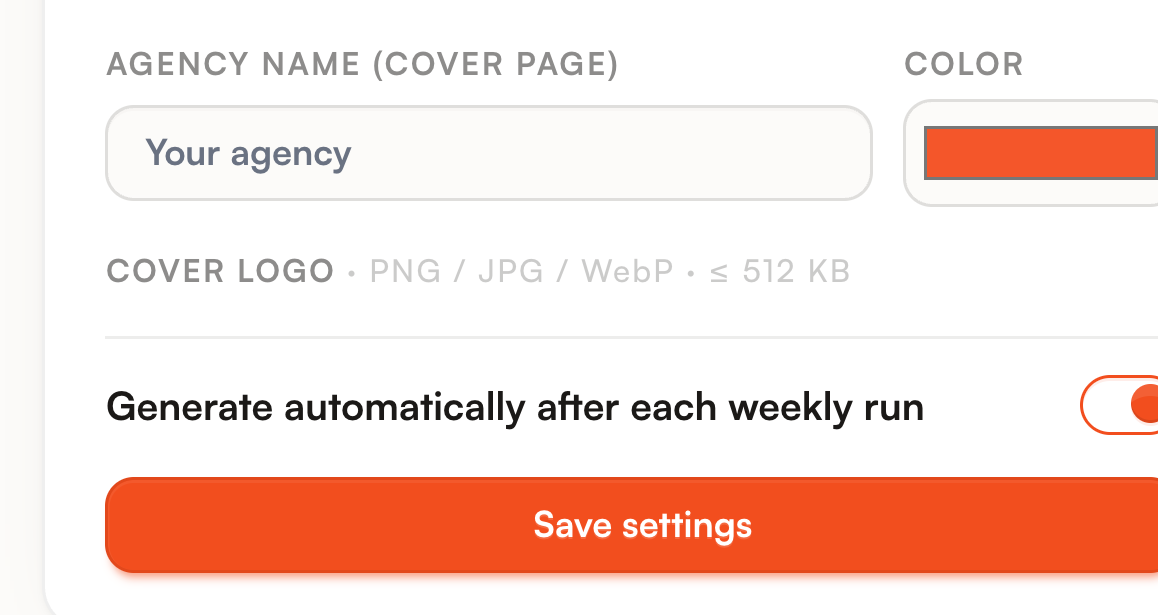
A report is configured once per project and then arrives on its own after every weekly run. Manual runs never trigger one, so nothing goes out to a client because you clicked refresh.
| Setting | What it controls |
|---|---|
| Sections | What the report contains. Cut what your client does not read. |
| Formats | What lands in their inbox. |
| Recipients | Who gets it. They receive the report without ever needing an account here. |
| Branding | Your agency name on the cover, and your accent colour carried through the document. |
The headline numbers come from the run that just finished, so the report and your dashboard tell the same story that week. Some sections, competitors and perception among them, are built from your current analytics state, which reads the latest result for each prompt and engine across your recent runs. That is deliberate: it keeps a section readable when one pair failed to come back.
Drop alerts
You should not have to open the dashboard to find out something broke. Turn on visibility drop alerts in Settings and pick how big a fall deserves an email.
The comparison is strict, which matters if you want to trust it.
| Rule | Why |
|---|---|
| Only weekly run against weekly run | A manual run covers a different set of prompts and engines. Comparing the two would send you false alarms. |
| Never on your first weekly run | There is nothing to compare against, so there is no such thing as a drop yet. |
| Never when a run came back empty | A collection failure on our side would look exactly like your visibility falling to zero. We do not send you an alarm about our own gap. |
The email names the prompts that fell the most, so it is a starting point for the diagnosis in the previous guide rather than just bad news.
That is the loop
Track the questions your buyers ask, read where you stand, find where you lose, ship one thing, measure it the following Monday, and let the report leave on its own.
A one-off audit tells you where you are today. Doing this every week for a quarter is what tells you whether you are winning, and it is the only version of this work that survives a client asking what they paid for.