Your first week with Promptrack
What happens from the moment you add your brand to your first action, when each thing runs, and what you should not conclude yet.
Day one: your setup
You give one thing: your domain. Everything below is derived from it, and everything is editable before anything runs.
Menu, footer, structured data and a few priority pages, to work out what you sell and to whom. This is also how your market and language are pre-filled: a .de domain sets Germany, otherwise we read the language declared on your homepage.
Not the brands you would name from memory: the domains that rank alongside you on Google for your own topics, filtered and named automatically. It is a starting list, and you decide what stays.
The purchase questions your buyers put to an assistant, in their language. Edit the list, drop what does not fit. This list is the single input that decides everything else, which is why it has its own guide.
Day one: your first run
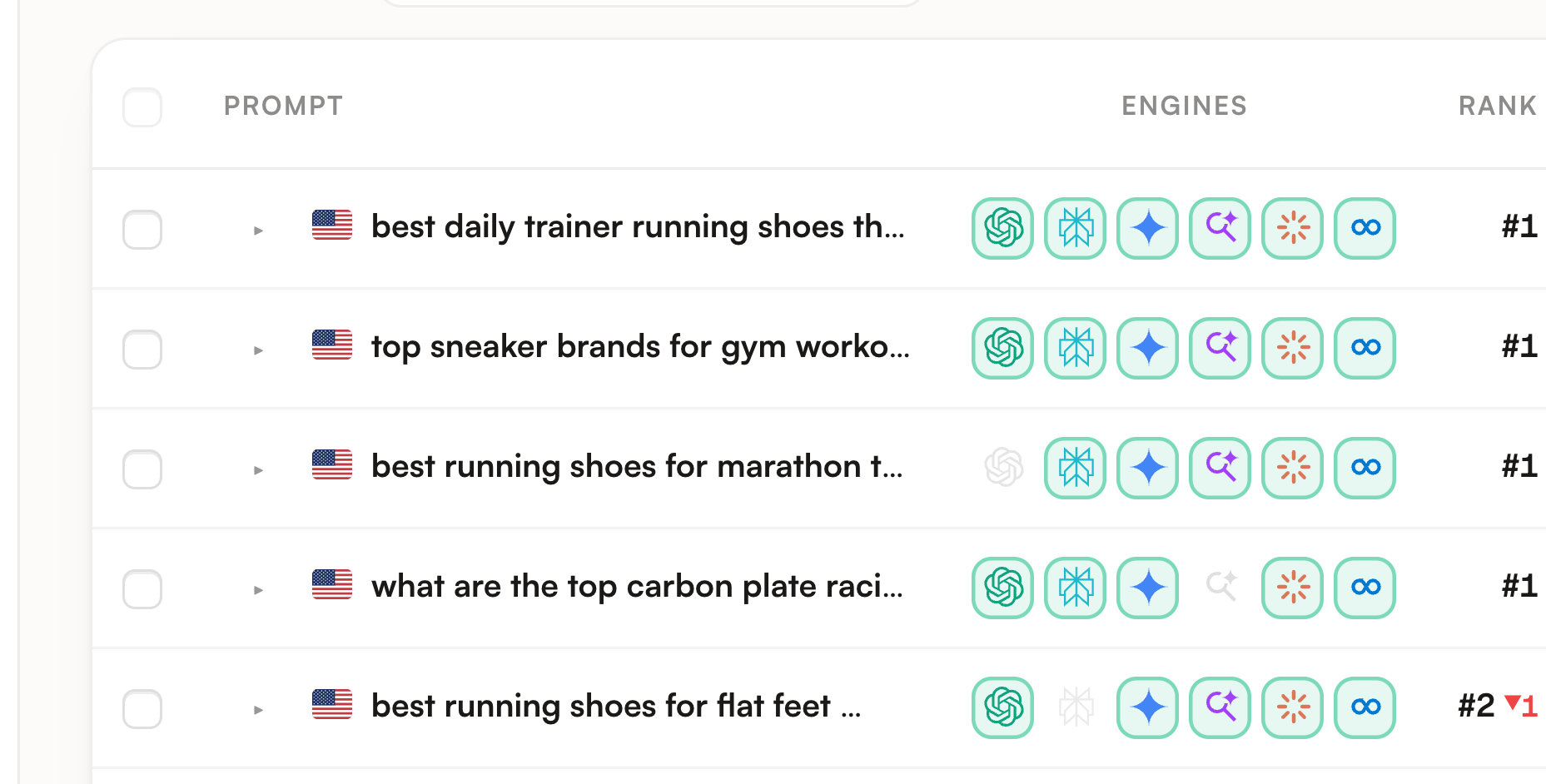
Your questions go out and the answers come back one by one. Three engines are on by default because they cover most of the buying journey; the other three are one click away in your settings.
How each engine is queried
This matters when you compare our numbers with what you see yourself, so here is exactly what happens.
| Engine | Default | What we query |
|---|---|---|
| Google AI Overviews | On | The real Google result for that query, in your market |
| Google AI Mode | Off | The real Google result for that query, in your market |
| ChatGPT | On | GPT-4o, OpenAI's model, through its API |
| Perplexity | On | Sonar, Perplexity's own model, with web search bound to your market |
| Claude | Off | Claude Sonnet, Anthropic's model, through its API |
| Copilot | Off | GPT-4o, OpenAI's model, standing in for Copilot |
Every question is asked from your buyers' market
A question about running shoes does not get the same answer in Germany and in Australia, so we never ask it from nowhere. The market you picked at setup is carried into every single query, and it is set per prompt, so one workspace can track several markets at once.
| Engine family | How the market is applied |
|---|---|
| AI Overviews, AI Mode | The Google query is run from that country, so you get the result a buyer there would actually see |
| Perplexity | The model is told to answer for that country, and its web search is bound to the same country |
| ChatGPT, Claude, Copilot | The model is told to answer as it would for a user in that country |
The language follows too: your questions are written in your buyers' language, not translated from English, which is why a German prompt set reads like a German buyer wrote it.
What to read first
Your scorecard is the top row of the Overview. Four numbers, and each answers a different question.

| Metric | Answers |
|---|---|
| Visibility score | On what share of the analysed answers does your brand appear at all? |
| Average position | When you do appear, how high are you in the answer? |
| Share of voice | Of all the brand mentions on your prompts, how many are yours? |
| Positive sentiment | When engines talk about you, how do they talk about you? |
Every Monday
Your questions are re-asked automatically and a new run lands. That is the whole point of the product: a single audit tells you where you stand, the weekly repeat tells you what changed and whether what you did worked.
The site audit runs separately, on Tuesday. It looks at your site as it is that day, so a change you ship on Monday evening is already in it.
Your first action
Every run ends with a ranked list. Take the card at the top of To do, the one with the highest estimated impact, do it, and read the following Monday. One action per week, measured, beats ten done blind.
When a number looks wrong
| You see | What it means | What to do |
|---|---|---|
| No average position | Either you were never named, or you were named in prose without any ranking. Both leave nothing to average | Open Prompts. The Absent filter lists the questions that never name you; the rest are mentions the engine wrote without ranking anything |
| No competitor suggested | Your topics are too narrow, or your site is too new to rank alongside anyone | Add two or three by hand in Competitors |
| An engine still spinning | Its answers have not come back yet, or some failed | Nothing. A failed pair is retried on the next run |
| Prompts that miss the point | The generated set did not catch what you sell | Delete them and write your own, then read guide 2 |