Build a prompt set worth tracking
Your prompt list is the single input that decides every number you will read afterwards. This is what makes a question worth tracking, and how to fix a set that misses your buyers.
A question, not a keyword
People do not type keywords into an assistant. They ask it something, in a full sentence, the way they would ask a knowledgeable friend. Your prompt set has to be written the same way, or you measure a conversation nobody is having.
| Not a prompt | A prompt | Why |
|---|---|---|
| yachts | where can I find a trustworthy used yacht listing | The first one has no buyer in it. Nobody is deciding anything. |
| crm software | best crm for a 5 person sales team | The constraint is what makes the answer name specific brands. |
| what is share of voice | which tool tracks my brand in ChatGPT answers | A definition question returns a definition, never a shortlist. |
The four intents, and why order matters
Every prompt is classified into one of four intents. The list you were given at setup is sorted by that classification, buying questions first, and that order is the order we suggest you spend your budget in.
| Intent | The person is | Worth tracking because |
|---|---|---|
| Purchase | ready to buy, sign up or hire | An answer here decides revenue this month |
| Comparison | weighing named options against each other | This is where you appear next to competitors, or do not |
| Discovery | exploring what would solve their problem | Earlier, larger, and where a shortlist is formed |
| Informational | learning how something works | Rarely. It returns explanations, not brands |
If you only ever read one thing on this page: a set made of purchase and comparison questions produces numbers you can act on. A set made of informational questions produces a flat zero that means nothing, because those answers do not name brands at all.
Where your starting set comes from
Nothing in that first list is guessed from your domain name. Three sources feed it.
A light crawl reads your menu, footer, structured data and a few priority pages, then classifies your site into one of twelve types. A marketplace and a SaaS do not get the same questions, and that classification is what stops a boat marketplace from being asked how fast a boat can go.
Your real non-brand search footprint, clustered into four to eight themes. Prompts are spread across every cluster, with more on the larger ones, so no part of your business is left uncovered.
Questions actually observed in assistant conversations around your domain. These are not invented, someone put them to an assistant. We deliberately do not present them as questions you already win: that dataset is not necessarily fresh, and promising you a citation we then measure at zero would be a contradiction.
What we refuse to generate, and why
Abstaining is part of the job. Several of the rules below exist because a real account received a bad prompt and told us about it.
| Refused | Example | Reason |
|---|---|---|
| Pure information and trivia | what is the 10% rule for yachts | The answer explains a rule. It never names a seller. |
| A single past year | where is the boat show in 2025 | Already stale. Two different years are kept: that is a real comparison. |
| Invented brand names | alternatives to a vendor that does not exist | An "alternatives to" prompt uses a competitor from your list, or is skipped entirely. |
| Keyword fragments | uk mileage | Under five words it is a search query, not something anyone says to an assistant. |
| Near duplicates | two phrasings of the same question | They would burn two slots of your budget to measure one thing. Different numbers keep them apart, because "size 10" and "size 12" are not the same question. |
| Existing customer questions | how do I reset my password | That person already bought. There is no visibility to win. |
How many to track
You can keep 200 active prompts across your whole workspace, every project included, and all of them run every week. That is the only limit on your plan. Projects and history are unlimited, and all six engines are available on every prompt.
Two hundred is a lot, and it is still a budget. Spend it on coverage before depth. Ten buying questions across ten themes will teach you more than a hundred variations of the same one, because the first set tells you where you are absent and the second tells you the same thing ten times.
Topics are for reading, not for filing
A topic is the buying theme a prompt belongs to. It is tempting to treat it as tidying, which is why it gets skipped, and skipping it costs you the single most useful view in the product.
Grouped by topic, a bad week stops being forty individual rows and becomes one sentence: you are absent on comparison questions, or you lost ground on one product line. That is a sentence you can act on, and it is the sentence your client wants in the report.
Adding your own
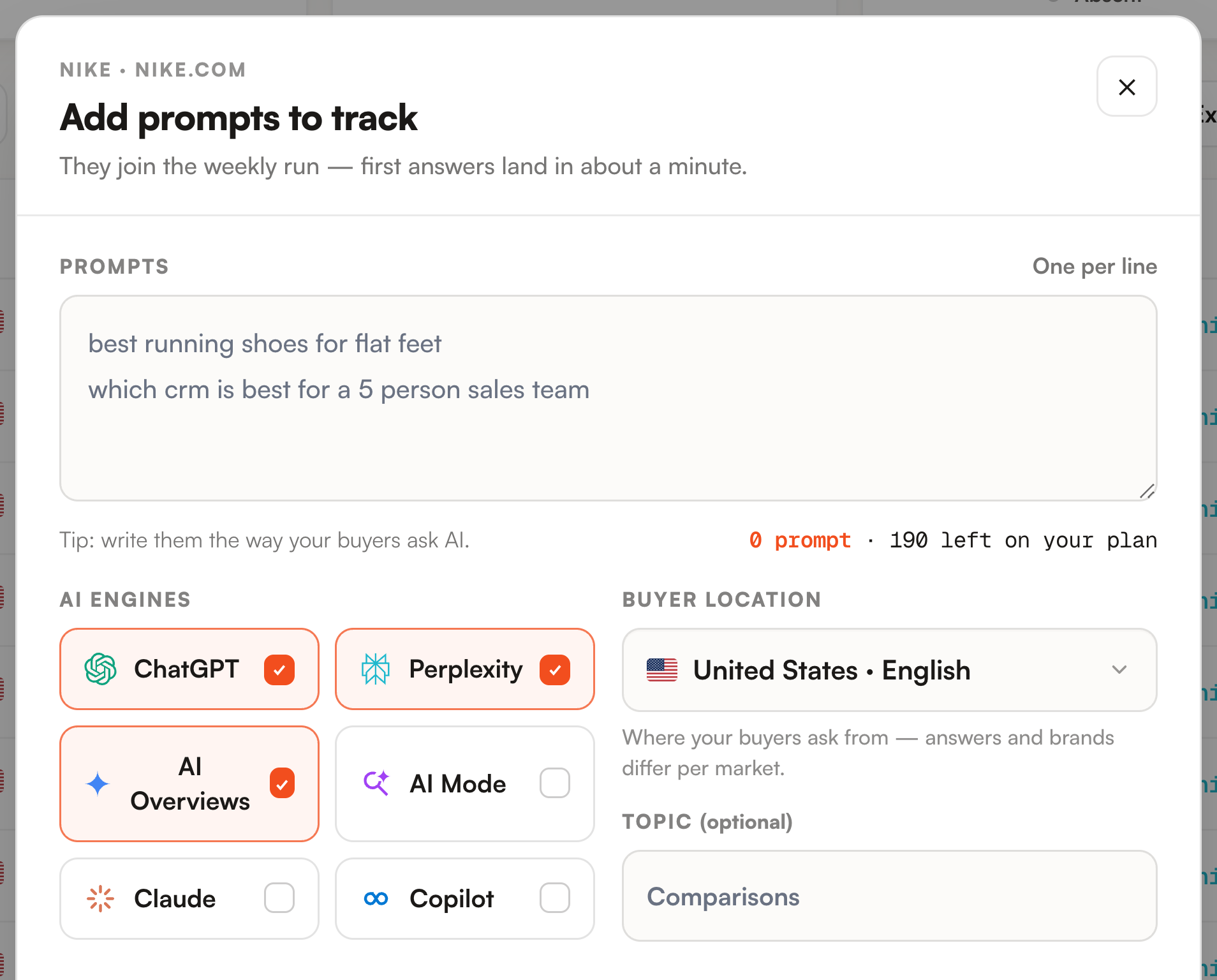
Add prompts opens a box where you write one question per line. Three settings apply to everything in that batch.
| Setting | What it does |
|---|---|
| AI engines | Which of the six run this batch. Set per prompt, so a question that only matters on one engine costs you one pair, not six. |
| Buyer location | The market the question is asked from. Set per prompt, so one workspace can track several countries side by side. |
| Topic | Optional, and it suggests the topics already in your project so you do not end up with three spellings of the same theme. |
Changing the set later
Edit freely. One consequence is worth knowing before you do it on a Sunday night: a prompt added today has no previous measurement, so it shows no trend until the following week. Its first run is its baseline, exactly like your first week.
That is also the argument for settling your set early. Every question you keep from week one is a question with a year of history in twelve months, and history is what turns a number into an argument.