Understand your first run
A run finished and the screen is full of numbers. Here is what each one is built from, and which of them is not true yet.
What a run actually is
One question put to one engine gives one answer. That answer is stored, analysed, and becomes one row. A run is all of those pairs, played once.
Engines are set per prompt, so the arithmetic is not uniform. A question that only matters inside Google can run on two engines while the rest of your set runs on three.
What "analysed" means
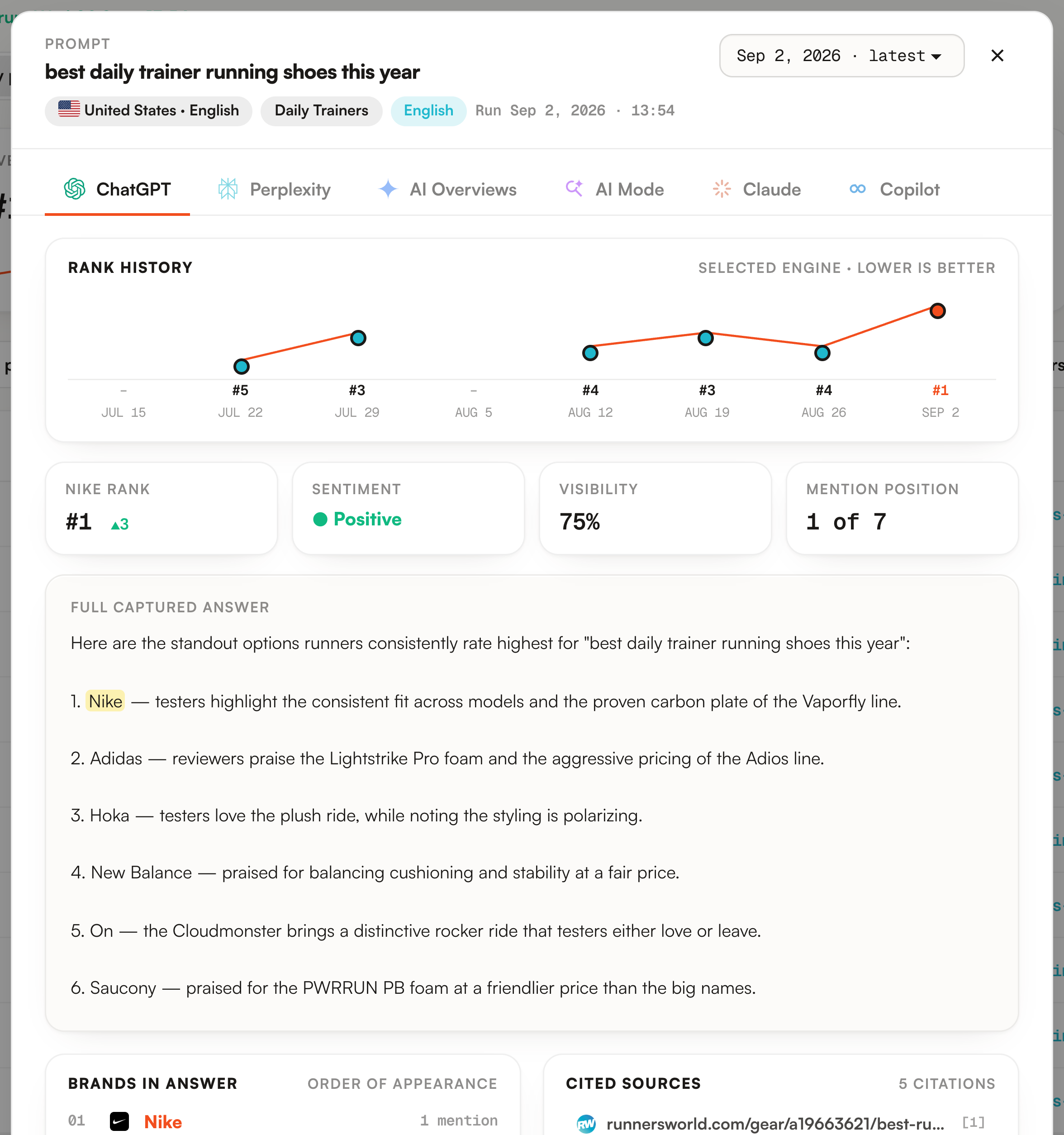
The raw answer is not the product. Every answer is read and five things are extracted from it.
| Extracted | Meaning |
|---|---|
| Mentioned | Whether your brand is named in the answer at all. This is the yes or no behind your visibility score. |
| Position | Where you come in the answer when several brands are named. First recommendation, or the fifth one down. |
| Sentiment | How you are talked about, when the answer says enough about you to tell. |
| Other brands | Everyone else named, in their order. This is what your share of voice is measured against. |
| Cited sources | The pages the answer points to. These are the pages the engine is reading about your market. |
Every one of these stays attached to the answer it came from, so any number on your dashboard can be traced back to the exact text that produced it. If a figure surprises you, open the answer.
When a pair fails
An engine can time out, refuse, or return something unusable. That pair is retried twice, a minute apart then five minutes apart. If it still fails it is marked as failed and left alone.
A failed pair is not a hole in your dashboard. Your current state is read per pair, from the last time that pair came back successfully across your recent runs, so one bad Monday usually leaves the numbers untouched. The next run creates the pair again from scratch. A pair only disappears from the picture if it has failed on every recent run, which is a real signal rather than a glitch.
Baseline against trend
This is the most common misreading of a first run, and it is worth being precise about.
Every arrow on your dashboard compares one prompt on one engine with the previous time that exact same pair was measured. Not this run against the last run as a whole, and not your brand against an average. Pair against its own past.
| After | You can read | You cannot read |
|---|---|---|
| One run | Where you stand: which prompts name you, who wins the ones that do not, what gets cited | Any direction at all. There is nothing to compare against. |
| Two runs | Your first real movement, prompt by prompt | A pattern. Two points is a line, not a trend. |
| Four or more | Whether what you shipped worked, and what is drifting on its own | Nothing much. This is where the product starts paying. |
Why the numbers moved after you subscribed
If you saw results before entering a card, you saw a preview, and a preview is deliberately smaller.
| Preview | Your first full run | |
|---|---|---|
| Prompts | Up to 30 | Every active prompt you kept |
| Engines | The 3 core ones | Every engine you enabled |
| Repeats | Never. It runs once. | Every Monday |
So a visibility score that shifts between the two is expected: it is a different denominator, not a change in the market. Treat your first full run as the real baseline and ignore the preview from then on.
Reading the Prompts table
This is the screen you will live in, so three columns are worth learning properly.
| Column | How to read it |
|---|---|
| Engines | One icon per engine that ran this question. A highlighted icon means that engine named you. Six greyed icons on a purchase question is your most actionable row. |
| Rank | Your best position across the engines that cite you, not an average. One engine putting you first is a real fact and we do not dilute it. |
| A dash instead of a rank | No engine gave you a place on that question. Either none of them named you, or they mentioned you in passing without ranking anything. The Absent filter isolates the first case, which is the shortest list of things worth fixing. |
Sort by rank and read from the bottom. The worst rows on your buying questions are the shortest path to a decision, and they are what the action plan is built from.