Find where you lose visibility
Your score is lower than it should be. This is the order to look in, because each screen rules out one cause, and stopping at the first one is how people end up rewriting pages that were never the problem.
Why the order matters
A low score has four possible causes, and they need completely different work. You are absent from the conversation, someone else owns it, the engine reads sources that never mention you, or the engine cannot read your site at all. Writing content fixes the first. It fixes none of the other three.
Five steps, twenty minutes, and you finish knowing which lever to pull.
Step 1. Where exactly are you absent
Open Prompts and switch the filter to Absent. What is left is every question where no engine named you.
Do not read it as a list yet. Read it for a pattern, and there are only three worth finding.
| What the list looks like | What it tells you |
|---|---|
| One whole topic, absent everywhere | A part of your business the engines do not associate with you. This is a content problem and it is the good case, because it is fixable by writing. |
| One engine absent, the others fine | Not a content problem. That engine is reading different sources, which step 3 will show you. |
| Scattered, no pattern | Usually phrasing. Compare an absent question with a similar one that works, and the difference is often a qualifier you never claim on your site. |
Note the topic with the most absences. You will carry it through the next four steps.
Step 2. Who is there instead
Go to Competitors and open the brand that keeps appearing on those questions. You get its prompts, its positions, and the sentences the engines actually wrote about it.
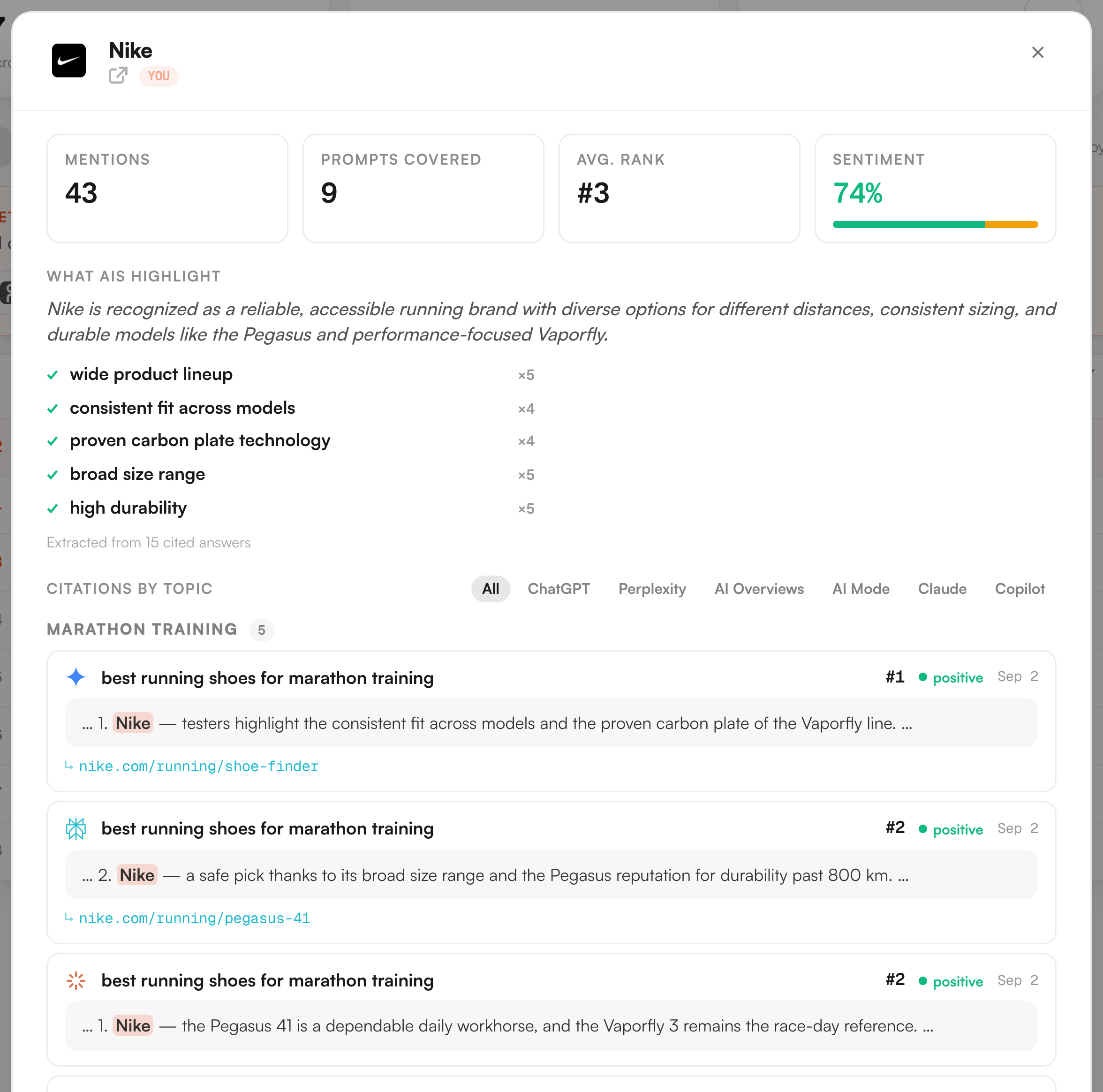
Read those sentences carefully. An engine that recommends a rival almost always says why, and that why is a claim they make somewhere on their site and you do not make anywhere on yours. That is the most directly actionable sentence in the whole product.
Step 3. What the engines are reading
Open Sources. Each row is a domain the engines cited when answering your prompts. Open one and you get how many answers quoted it, how many of its pages, how many of your prompts it touched, and how many of those prompts did not name you.
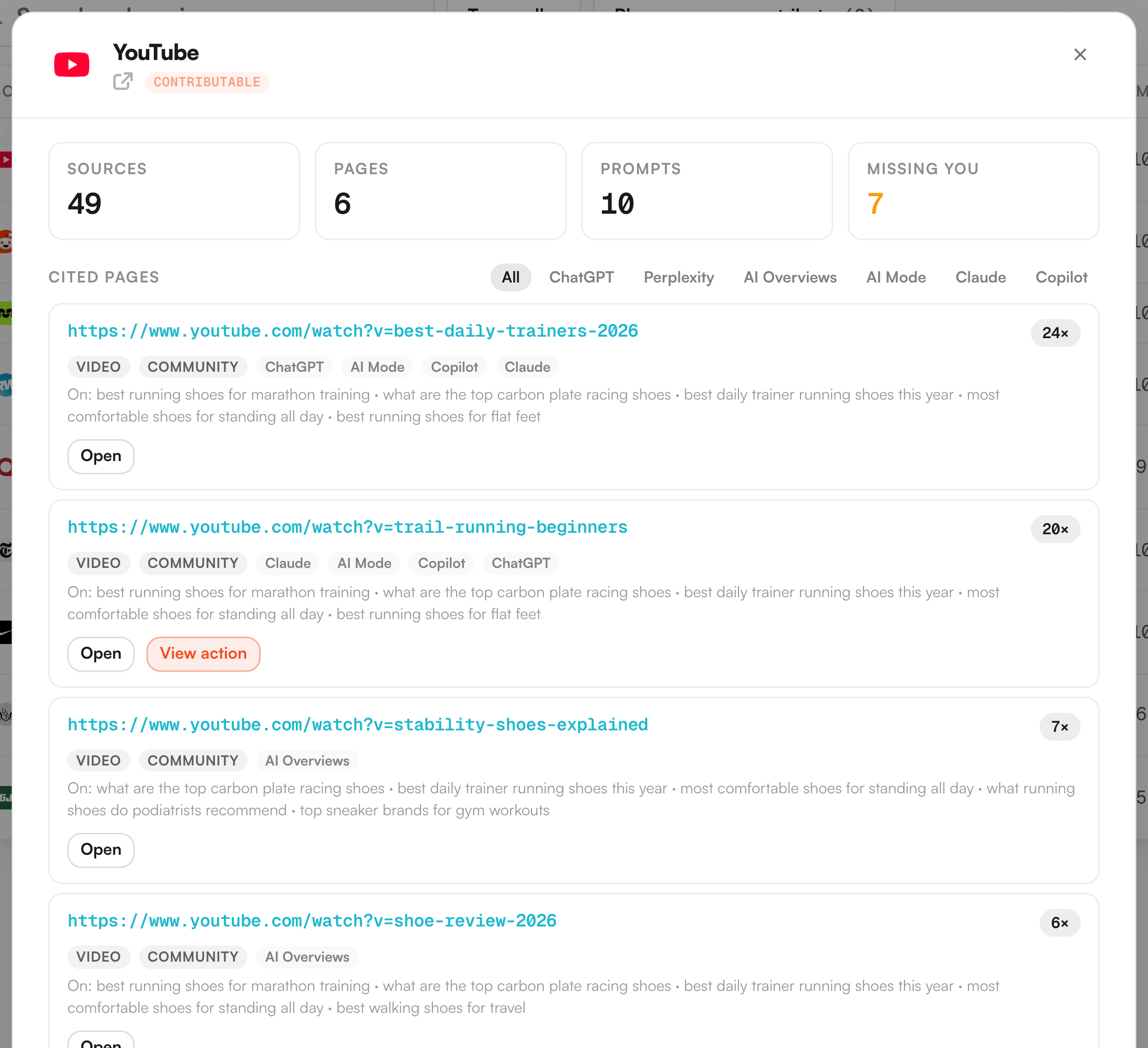
A high Missing you count is a specific, workable finding. The engines trust that domain on your topic and you are not on it. Depending on what the domain is, that means a listing to claim, a review to earn, a thread to answer, or a page that should mention you.
This is also the step that explains a single weak engine. If one engine leans on a domain the others ignore, its opinion of you comes from a source you have never worked on.
Step 4. What the engine searched before answering
An engine does not answer from memory alone. It often runs its own searches first, and Fan-out queries shows you those searches.
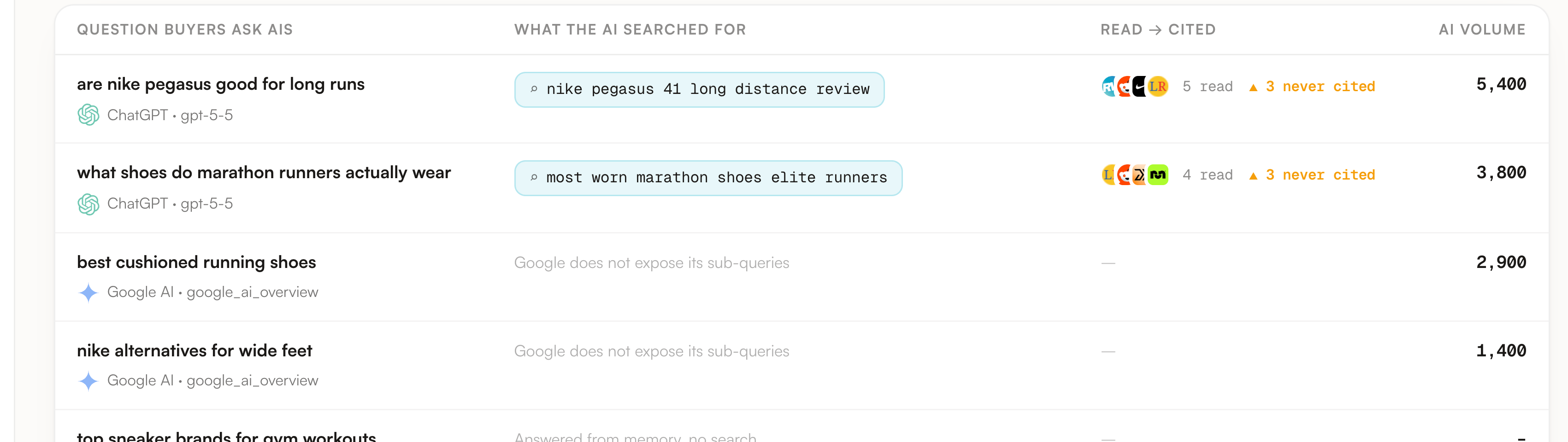
This is the closest thing to reading the engine intent. A prompt about running shoes that fans out into durability, price and injury queries tells you what the answer is really being built from, and those are the angles your page has to cover to get picked up.
The same screen carries Read, but never citing you: domains an engine opened while researching your market and then quoted in none of your answers. Read it as a shortlist of places the engines consult without crediting them, worth a look before you invest anywhere new.
Step 5. Can the engine even read you
Last, and first if the previous four looked fine: the site audit checks whether AI crawlers can reach your pages at all. It scores three things.
| Category | Question | The finding that changes everything |
|---|---|---|
| Bot access | Are AI crawlers allowed in? | A robots.txt rule blocking an AI crawler. Nothing else you do matters until it is lifted. |
| AI indexability | Do the pages actually load? | A page that AI already cites returning an error or carrying noindex. You are losing a citation you had already earned. |
| Content readiness | Is there anything to read on arrival? | Pages whose first HTML is nearly empty because everything renders later. A crawler that does not wait sees a blank page. |

Putting the five together
Each symptom points at one lever. This is the table to come back to.
| What you found | The lever |
|---|---|
| Absent on a whole topic, competitors present, sources you are not on | Presence. Get onto the sources the engines already trust on that topic. |
| Present but always last, and rivals get a clear reason in the text | Content. Make the claim they make, on a page that says it plainly. |
| Fan-out queries about angles your pages never address | Coverage. The question behind the question is not answered anywhere on your site. |
| A crawler blocked, or cited pages failing | Access. Fix this before anything else. It is cheap and it caps everything. |
| One engine weak, the rest fine | Sources. That engine reads a different set, and step 3 named it. |
You do not have to do this by hand every week. The action plan runs the same reasoning on your data and ranks what comes out of it, which is the next guide.